
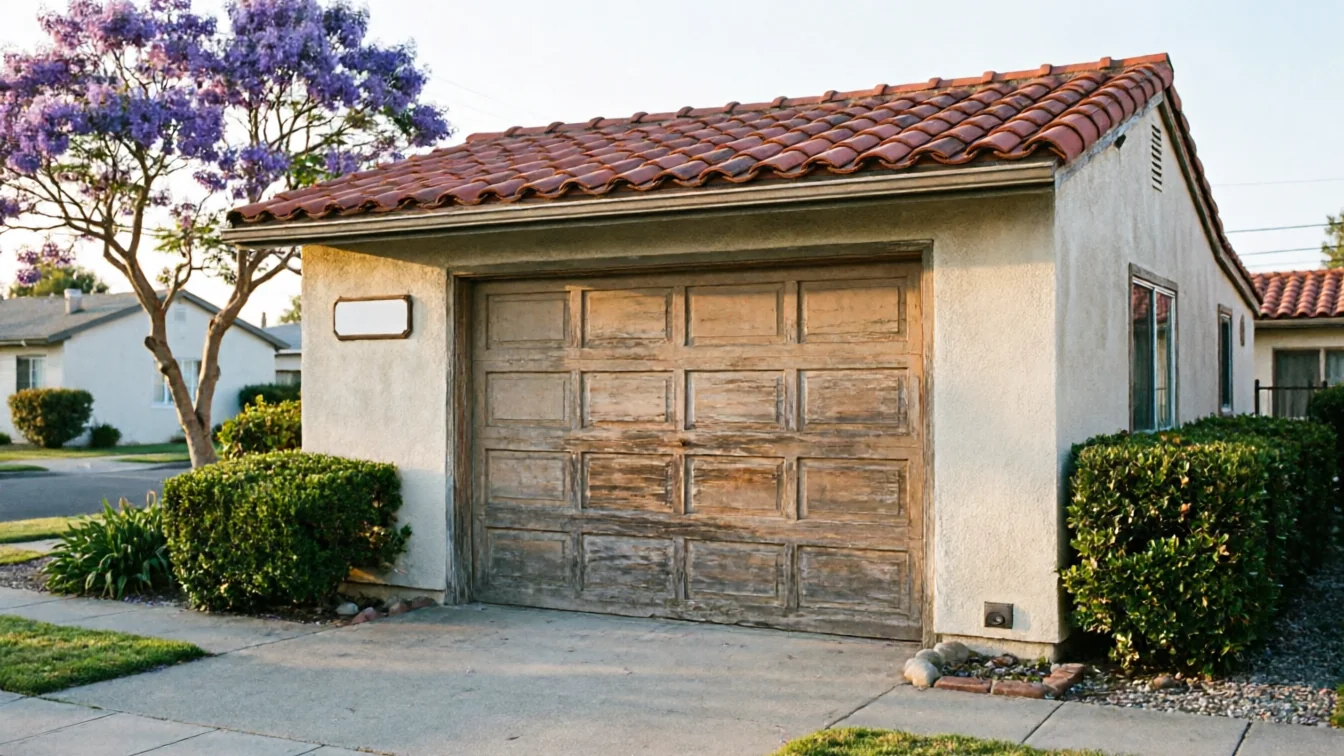
Turlock, CA · Garage Door Service
Is Your Turlock Garage Door Worth Fixing, or Done
Turlock homes mostly date 1945-2000, median 1987. Here's how that age and the Valley heat decide whether your door is worth repairing or replacing.
- Repairs & new doors
- Springs & openers
- Serving 4 nearby communities
The Problem
Most houses around Turlock went up between 1945 and 2000, with the median build year sitting at 1987. That means a huge share of the doors we get called on are somewhere between 25 and 40 years old, with hardware and springs that have never been swapped out. A door that age wasn't built for the kind of daily heat cycling it's been through since. Steel panels on those older sectional doors have usually gone through three or four decades of expansion and contraction, and the torsion springs rated for that door's weight were sized for conditions that don't match what the Valley throws at them now. When a homeowner calls about a door that's "just a little slow" or "making a new noise," nine times out of ten the door itself is original to a house built in that 1945-2000 window, and the question isn't whether something's wearing out - it's whether what's wearing out is cheap to replace or load-bearing.
What Local Conditions Do
Turlock sits in a severe-heat climate band, and that matters more for a garage door than most people think. Steel panels expand under direct sun and contract overnight, and over enough years that cycling works at the seams, the hinges, and the track alignment. On a door built in the 1980s or 90s - the bulk of the stock here - the steel gauge and the weatherstripping were specced for a different expectation of heat exposure than what's actually been logged since. Nylon rollers dry out and crack faster under sustained heat; steel rollers on older doors develop flat spots that show up as a thump every time the door opens. None of this is dramatic. It's slow wear that adds up, and it's why a 1987-era door often needs more frequent spring and roller attention than a door half its age, even with identical use. The heat doesn't break a door in one day. It just shortens the interval between the small failures.
When to Call Someone
If your door is from that 1945-2000 build era and the track is still original, worth a call before the spring goes. A torsion spring under tension that's been cycling through Valley heat for 30-plus years doesn't give much warning - it can let go suddenly, and a broken spring on a heavy double door isn't a weekend fix with hand tools. Call if the door is noticeably heavier to lift by hand than it used to be, if it drifts off level when you open it, or if the opener strains and reverses partway up. Those are spring or cable symptoms, not opener symptoms, no matter what the opener's error light says. Also worth a call if panels have started to bow or separate at the seams - on an original door that old, that's usually the steel giving up, not something you tighten back into shape.
The Common Mistake
The mistake we see most in houses from that 1945-2000 era is replacing the opener and assuming that fixes the door. An opener swap is the easy, visible repair - it's the part homeowners can see failing. But if the door itself is original, a new opener just means a stronger motor straining against the same worn springs, dried rollers, and misaligned track. That's not a small thing in a household budget - with the median household income here around $75,751, a repair bill is something people plan for, not something to pay twice because the first fix addressed the wrong part. Here's the honest limit: we don't always recommend fixing an old door. Past a certain point - cracked panels, a bent track that's been forced straight more than once, hardware nobody stocks replacement parts for anymore - a full door replacement costs less over five years than a string of patch repairs on a 35-year-old door.
Frequently asked questions
How do I know if my Turlock garage door is original to the house?
If your house was built in the 1945-2000 window - which covers most of the area - and you've never had the door replaced, it's probably original. Look for steel gauge thickness, no insulation layer, and exposed torsion springs on a single center shaft rather than two separate springs.
Does the Turlock heat actually shorten a garage door's life?
Yes. The severe-heat climate here means more expansion and contraction cycling on steel panels and faster drying of rollers and seals than a milder climate would produce. It doesn't cause sudden failure, but it shortens the gap between maintenance needs on an older door.
Is it ever worth fixing a 1980s door instead of replacing it?
Sometimes. If the track and panels are straight and the only issue is a spring or a roller, repair usually makes sense. Once panels bow, hardware is obsolete, or you've already paid for two separate repairs in a year, replacement is usually the cheaper path over time.
Related garage door services in Turlock
More garage door guides
Book garage door service in Turlock
Call now or request a quote - tell us what the door is doing and where you are.