
Turlock, CA · Garage Door Service
Why Your Garage Door Jumps the Track
Turlock's 1945-2000 housing stock and severe summer heat both push garage door tracks out of line. Here's why it happens and when a call beats a DIY fix.
- Repairs & new doors
- Springs & openers
- Serving 4 nearby communities
The Problem
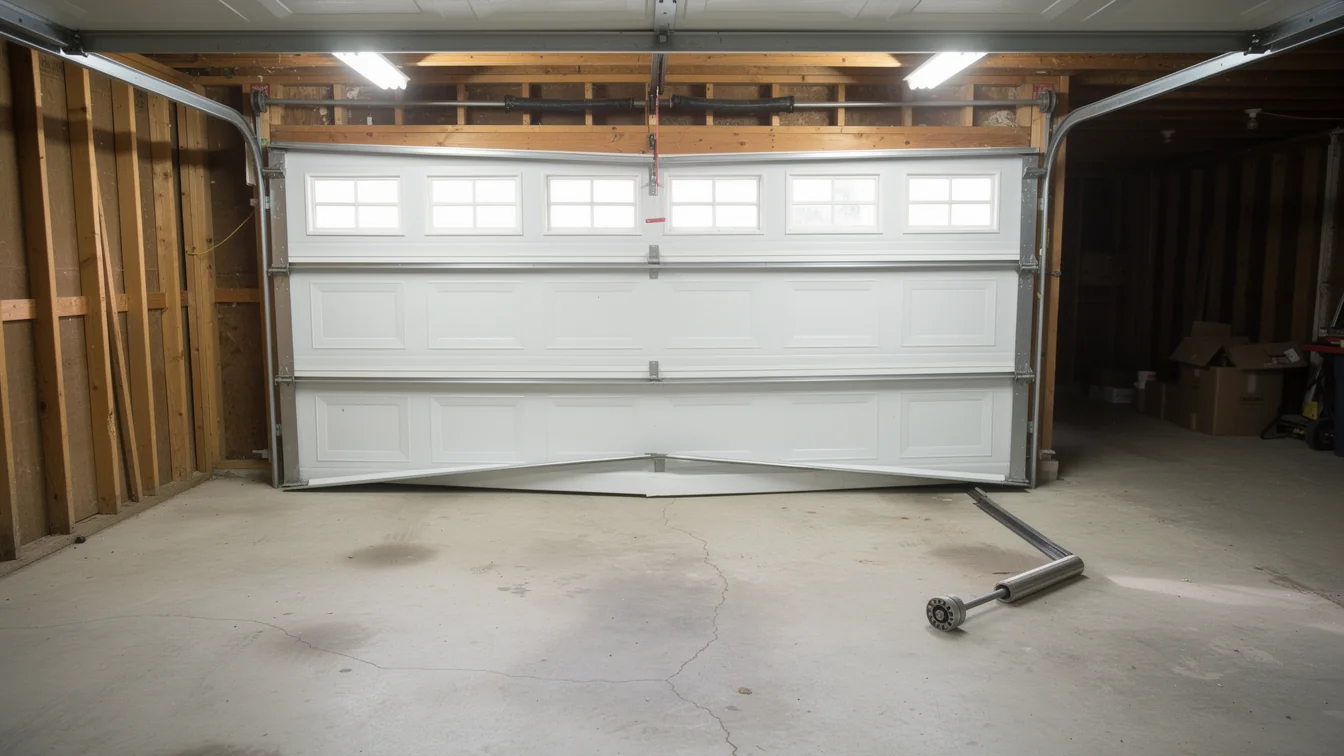
A door off its track doesn't happen on its own. Something pushes it there - a roller that's worn thin, a bent track rail, a bracket that's loosened over the years, or a spring that's no longer pulling evenly on both sides. Once one roller slips past the track lip, the door binds, the opener strains against it, and you get that grinding scrape or the door stopping dead halfway up.
In Turlock, the age of the housing stock matters more than people expect. With most homes built between 1945 and 2000, and the bulk of the local stock dating to the 1980s and 90s, a lot of garage doors and their hardware are original or close to it. Galvanized track rails from that era don't flex the way newer rolled-steel track does, and after thirty-plus years of expansion and contraction they develop small kinks you can't always see from the floor. A kink doesn't stop a door from running - until the day it does.
What Local Conditions Do
Turlock sits in a severe heat climate band, and that matters for a steel track bolted to a wood or steel jamb. Through the hottest stretches of the year, the track rail and the framing around it expand at different rates. The track is metal, the jamb lumber in a lot of these 1980s-and-90s-built houses is standard dimensional fir, and the repeated heat cycling works the lag screws loose at the brackets over time. A bracket that's backed out half an inch is enough to let the track drift out of plumb, and an out-of-plumb track is the single most common reason a roller walks off the rail.
This isn't a one-season problem. It's cumulative - one more hot summer, one more set of brackets that loosen a little further. Houses built in the median year for this area, 1987, have had roughly that many heat cycles to work on their hardware, which is why track misalignment shows up so often in homes of that vintage rather than in anything built in the last decade.
When to Call Someone
Some signs mean stop using the door and call. If you can see daylight between a roller and the track, if the door is visibly tilted in the opening, or if it's come off the track on one side only, don't run the opener again - you risk bending the rail further or pulling a panel loose. A door that's merely noisy, or slow, or sticking slightly at one point in its travel, usually isn't an emergency, but it's worth getting looked at before it becomes one.
If your garage was built in that 1945-to-2000 window and you haven't had the track brackets checked in the last few years, loose hardware is a reasonable first guess for any new grinding or shuddering sound. A quick inspection can usually tell the difference between a bracket that needs retightening and a track that's bent enough to need replacing.
The Common Mistake
The mistake we see most is someone trying to bend the track back into alignment by hand or with a pry bar after the door's already jumped it. It can look like it worked - the door goes back onto the rail and runs for a few more weeks - but a track that's been forced back into shape rarely holds true, and the next derailment tends to happen at a worse moment, like mid-cycle with the door half open.
We'll say plainly that not every off-track door needs a new track. Sometimes it's just the rollers, sometimes it's the brackets, and replacing the whole rail when the fix is an eight-dollar roller is money you don't need to spend. But we also won't tell you a cracked or visibly bent rail is fine to leave - that's the one repair we don't shortcut, because a track that fails under load can bring the door down.
Frequently asked questions
Why does my garage door keep coming off the track in summer?
Heat cycling is the likely driver. Turlock's summers push steel track and wood framing to expand and contract at different rates, which works bracket screws loose over a season. Once a bracket backs out, the track shifts slightly out of plumb and a roller can walk off the rail, especially on older hardware.
My house was built in the 1980s - is that relevant to a track problem?
Yes. A lot of Turlock's housing dates to that decade, and original track hardware from that era has had three to four decades of seasonal heat cycling to work screws loose and develop small kinks. That's a common reason homes of that vintage see off-track issues more than newer builds do.
Can I push the door back onto the track myself?
We'd rather you didn't. Forcing a door back onto a bent or shifted track can hold temporarily but rarely lasts, and it raises the odds of a worse derailment later, sometimes with the door partly open. If a roller's visibly off the rail, it's worth a call before running the opener again.
Does a bent track always mean I need a full replacement?
No. Often it's a worn roller or a loose bracket, not the rail itself. We check which it is before recommending anything. A visibly bent or cracked rail is the exception - that's a safety issue and not one we'd leave as-is, but it's not the most common cause of a door coming off track.
Related garage door services in Turlock
More garage door guides
Book garage door service in Turlock
Call now or request a quote - tell us what the door is doing and where you are.