Turlock, CA · Garage Door Service
Openers and Power Outages in Turlock Homes
How Turlock's 1945-2000 housing stock and severe summer heat affect garage door openers during power outages, and when a repair call makes more sense than a reset.
- Repairs & new doors
- Springs & openers
- Serving 4 nearby communities
The Problem
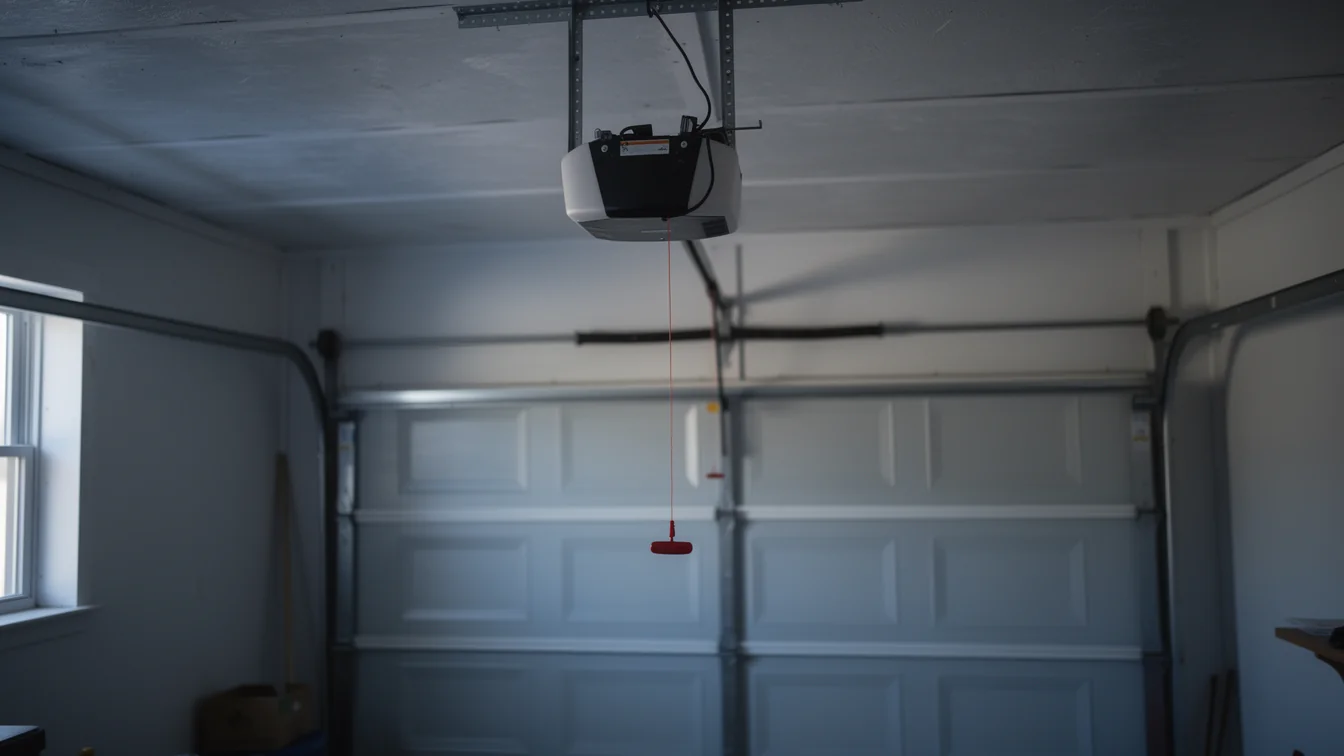
Most houses in this service area went up between 1945 and 2000, with the median landing around 1987. That means a lot of openers out there are original equipment or close to it - chain-drive units bolted to rafters, logic boards from an era before battery backup was standard, and wall buttons wired straight through with no smart-home bridge. When the power drops, even for a few seconds, these units don't just pause. Some lose their travel limits. Some need the whole remote fleet re-paired. A homeowner who's owned the house fifteen years and never touched the opener often doesn't know where the manual release cord even is until the power's out and the door won't budge.
This isn't a defect story. It's an age story. A door and opener that have run fine for two or three decades aren't broken - they're just old enough that a power event exposes what a stable grid used to hide. The fix isn't always replacement, but it's rarely as simple as flipping the breaker back on and expecting the remote to work like nothing happened.
What Local Conditions Do
Across the roughly 25 neighborhoods that make up most of this stock, the dominant build era is the 1980s and 90s. That's relevant here because this area sits in a severe heat band, and sustained high heat is hard on the exact components that fail during a power outage - capacitors on the opener's logic board, the thermal overload switch on the motor, and the plastic drive gear that's already brittle from decades of attic-level temperatures above the garage ceiling.
A power outage on a mild day is an inconvenience. A power outage during a heat stretch, on a thirty- or forty-year-old opener that's already running hot, is often the moment the motor doesn't restart at all. We see this pattern show up more in houses from that original 1980s-90s wave than in newer construction, simply because the parts have had more summers to degrade. With 44,071 owner-occupied houses across this area, a meaningful share are still running pre-battery-backup openers that weren't built with sudden outages in mind.
When to Call Someone
If the power comes back and the opener hums but the door doesn't move, don't keep hitting the button - that's usually a stripped gear or a tripped thermal switch, and repeated tries just finish the job. Pull the manual release, move the door by hand, and check whether it swings freely. If it does, the opener is the problem, not the door itself, and that's a call-now situation rather than a wait-and-see one.
If the door is heavy or uneven to lift by hand, stop - that points to a spring issue, not the power event, and running the opener on a bad spring can snap a cable or bend a track. At a median household income of $75,751 here, most owners aren't looking to replace an opener on a whim, so it's worth having someone look at whether the board, the gear, or just the remote programming took the hit before assuming the whole unit is done.
The Common Mistake
The mistake we see most is homeowners assuming a power outage problem is a programming problem, when it's actually heat damage that the outage just revealed. Reprogramming the remote fixes nothing if the logic board already has a cooked capacitor from a summer of highs sitting on an opener mounted in an attic-temperature garage. People spend an afternoon reading the owner's manual and reprogramming three different remotes before calling anyone, which delays a straightforward fix.
The honest limitation: we can't always tell over the phone whether it's the board, the gear, or the capacitor - that takes hands on the unit. And if the opener is original to a house built in that 1945-2000 window, parts for some older chain-drive models are genuinely hard to source, which sometimes makes replacement the more sensible call than chasing a part that's backordered for weeks. The same heat load that hits homes here also reaches Denair, four miles out, and Keyes, five miles out, so this isn't a one-street issue.
Frequently asked questions
Why did my opener stop working after the power came back on?
Usually the travel limits reset wrong, or the thermal overload switch tripped from heat and needs time to cool before it'll run again. On older units, a power outage can also finish off a logic board capacitor that was already weakened by years of garage heat. Try the manual release to rule out a spring problem first.
Is my opener too old to be worth fixing after a power event?
If it's original to a house built in the 1980s or 90s, parts availability is the real question, not just age. Some chain-drive models from that era are hard to source parts for, which can tip the decision toward replacement. A straightforward board or gear issue on a newer unit is usually a repair, not a swap.
Should I unplug my opener during a power outage?
Unplugging prevents a surge from hitting the board when power restores, which matters more here given how many openers in this area are original to older construction without surge protection built in. It's a cheap habit that can save a logic board that's already stressed from years of summer heat.
Related garage door services in Turlock
More garage door guides
Book garage door service in Turlock
Call now or request a quote - tell us what the door is doing and where you are.